
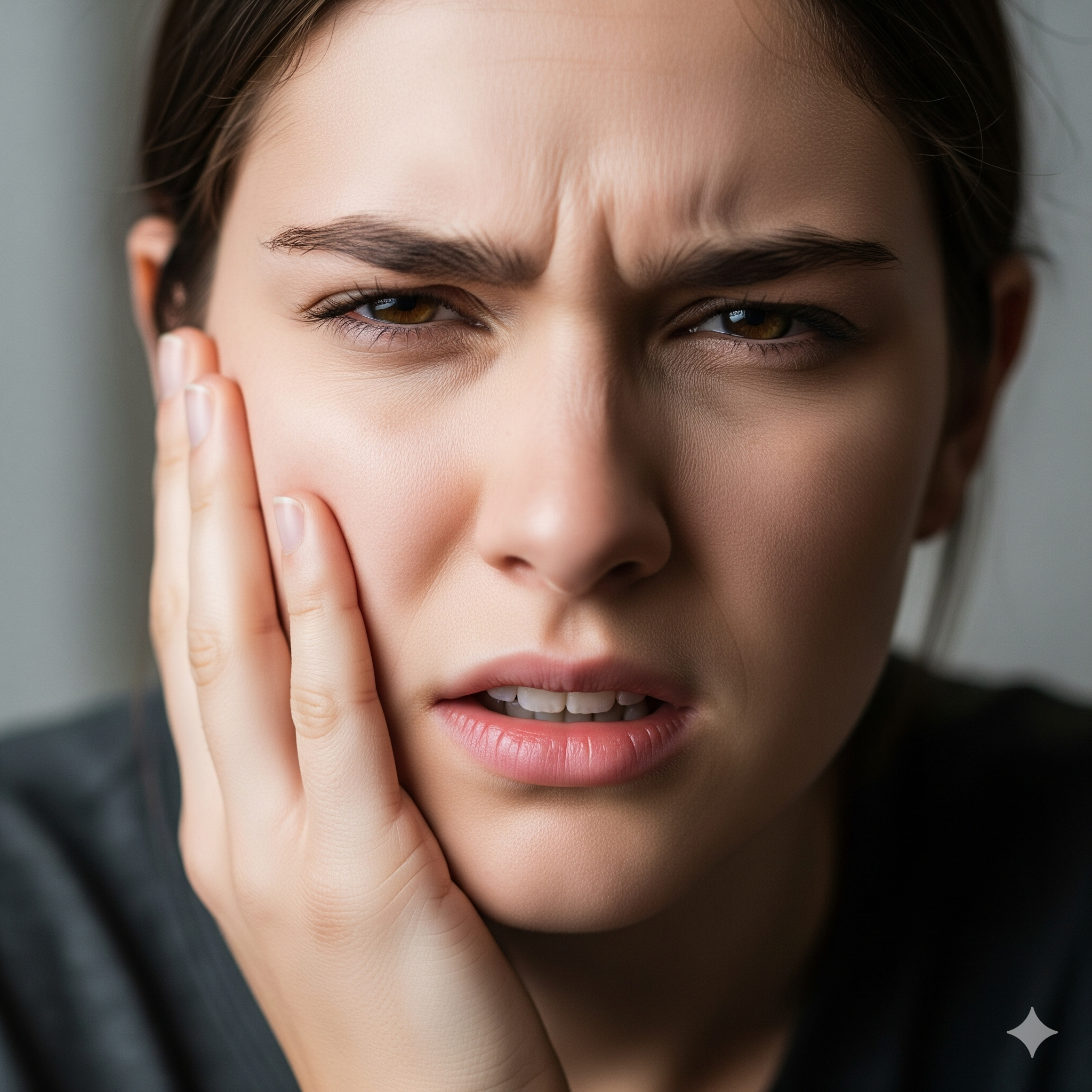
There are many different kinds of facial pain people commonly suffer from, with various causations and symptoms. The Facial Pain Association offers a great definition:
Facial pain refers to pain experienced in any part of the face, including the eyes and mouth. This type of pain can vary in intensity and character, ranging from sharp or dull to throbbing or achy. It can also be acute or chronic and caused by either nociceptive or neuropathic factors. In some cases, facial pain can be a long-term condition.
Facial pain, like many conditions, can be disturbing to people who are unsure of where the pain is coming from, or why it is happening. Pain around our face feels very personal, especially when it makes talking, eating, and other “normal” activities feel difficult.
A question people commonly have is: who should I see for diagnosis & treatment: my dentist, my PCP, my chiropractor, my acupuncturist, or someone else, perhaps a specialist? Who can assist me in getting to the bottom of why my pain is happening?
I can tell you from personal experience that in many cases, facial pain requires a team of people to help you. In my storyline, I had to see a lot of people who didn’t know how to diagnose or treat it, before I saw someone who did. It was painful to me and difficult to swallow that most people I worked with, including my teachers, had no clue what was going on with me. I thought of Chinese Medicine doctors as almost mythical figures, who could find out the “root cause” of someone’s disease by looking at their tongue and taking their pulse.
My journey started out with intermittent sharp, stabbing pain in 2017, behind an upper tooth. Like most people, I went to the dentist. They did a bite test and various examinations, but were unable to find anything wrong. So, I went home and hoped for the best, essentially doing nothing about my problem, and eventually it went away. Before I left, they tried to sell me some Invisalign, positing that malocclusion and my overbite might have been the problem. This is when I started learning about how much profit motivation can go into diagnosis and treatment.
Years later, when I was in acupuncture school, I had an acute attack of sharp pain that many would describe as completely debilitating. It felt like a lightning bolt struck across my face, but deep inside. I was terrified, and more terrified of what I saw online when googling my symptoms: trigeminal neuralgia. As I sobbed on the floor, rocking back and forth in pain, I wondered if there was anything that could help me. I had built up many biases about what my life would be like, and how Qigong and Acupuncture were going to be my long term health plan.
As I researched the condition, I received regular acupuncture and drank smoothies for what seemed like weeks, because both talking and chewing would incite the pain. I was uninsured and living in my classmates’ basement in the early throes of the COVID pandemic. I was weeping the loss of a relationship, the separation from my child, and the destruction of my life plan.
Part of me wanted acupuncture to fix my problem, as it was the thing I was studying, and I wanted to get better without using Western Medicine. After about a month of pain, it finally relented, and I went into remission. I didn’t know it, but this is a commonality among trigeminal neuralgia sufferers. However, every time the pain returns, it can and likely will be worse. During this time I was also practicing Baguazhang and Qigong and keeping my blood and qi moving, perhaps it helped, or perhaps it just distracted me.
As is often the case, forgetting is easier than doing something about the problem. The problem mostly subsided into the background, with minor flare-ups here and there, some lasting a few days, and some a few weeks. I truly believed that I had a mild case of facial pain caused by either TMJ (what my dentist told me) or a cervical spine misalignment (what an acupuncturist and chiropractor told me). I spent hours stretching and doing all sorts of things to attempt to reduce my pain levels when the flare-ups would happen, and it somewhat worked, until it didn’t.
In early 2024, I took a Chinese Medicine CEU with a local Portland teacher to learn an advanced pulse diagnosis method. While attending class, I started having severe pain. In these circles of people who are putting on such a good face to “know” what disease is, and to control it with their diet and lifestyle, herbs and acupuncture, and to have the answers to diseases from classical sources, it was difficult for me to admit that I was having pain, a lot of it. I felt like the expectation was to be put together and a certain kind of person, what poor people probably feel around rich people, not feeling good enough. I didn’t feel safe enough to just break down and cry, because I felt like it was a failure to not have realized the deeper goals of self-care.
The more I talked to the teachers, one in particular, I grew angrier that they were so confident about how to diagnose. As they, and a class of students, checked my pulse and came up with an entire sheet of diagnostics, no one wrote down pain. No one could tell, their ability to detect what was right in front of them was more limited than was being expressed. This is when I first learned that many of the people around me were in some ways just as clueless as myself, but better at pretending they knew something.
I don’t blame anyone for not knowing what was going on with me, and certainly not the teachers hinted at above. I have talked about this issue with them openly, and they are aware of my position. What I do have frustration around is people attempting to find causative factors that are inaccurate or not helpful, either due to ignorance or needing to sell something. Their inability to say: “I don’t know” was also quite disturbing to me. The look on their face as they made up something and did what they were going to do anyway. The story above is not even close to the only one. The pits of alt-med are deep, and we’re seeing that come out during this time in the USA with our public health institutions.
That being said –little did we all know that the true root cause of my trigeminal facial pain was not idiopathic, a cervical misalignment, my crooked teeth, my diet, or my lifestyle — it was a gigantic cyst pressing on my cranial nerves and my CNV, the trigeminal nerve, specifically. It was something that needed a CT scan or an MRI to diagnose.
What I learned from this is that diagnosis should be nuanced and careful, and in many cases multidisciplinary. We have a responsibility to ourselves and our patients to learn about the things our patients are suffering from, and not attempt to shoehorn our personal beliefs onto the situation.
So, am I saying that TCM people and many allied health professionals are clueless about TN and facial pain? To some degree, yes, but that isn’t the take I want to leave you with. While the majority of early interventions and medications did not work at all, they created a pathway for me to move forward in, a way to navigate the experience I was having, and showed me how to find out and admit if something is right for me and working, or not.
That process is something I want to share more about, and how Chinese Medicine and Acupuncture can intersect with that goal. I would love to help anyone with TN, TMJ, or facial pain in general come up with the best pathway for healing possible, even if it means not getting acupuncture or doing Qigong. To me, that is what being a true healer is about. Stay tuned for Part II.
Zachary Krebs L.Ac